







Recent Posts

Featured Testimonials

  • "I never expected to be in a motorcycle accident, but when it happened, The Law Office of Roderick C. White was there for me every step of the way. Their attention to detail and aggressive representation ensured that justice was served. I can’t recommend them highly enough."

    Andrae S.
  • "Roderick C. White and his team went above and beyond after my slip and fall injury. They were not only my advocates but also my support system throughout the entire process. Thanks to their hard work, I received a compensation package that truly reflected my pain and suffering."

    Sean M.
  • "I never expected to be in a motorcycle accident, but when it happened, The Law Office of Roderick C. White was there for me every step of the way. Tanner’s attention to detail and aggressive representation ensured that justice was served. I can’t recommend them highly enough."

    Levy G.
Facebook
X (Twitter)
Instagram
Tiktok

CONTACT US NOW​

We are available 24 hours every day of the week to help you get the compensation that you deserve.

10 Rights You Have After an Accident/Injury

After an accident or injury caused by someone else’s negligence, you have specific legal rights that protect you and your family. Many people don’t know these rights exist, which is why insurance companies count on silence. This guide explains the 10 most important rights you need to know if you’ve been hurt in Texas, Missouri, Illinois, or Kansas.

Right 1: The Right to Medical Treatment and Recovery​

Your first right is straightforward but crucial: you have the right to seek medical treatment immediately after your accident or injury. Don’t delay. Get checked by a doctor, go to the emergency room, or visit an urgent care clinic right away.

Why does this matter? Insurance companies and defense lawyers often argue that your delay in seeking treatment means your injuries weren’t serious. Document everything—your medical visits, test results, medications, and follow-up appointments. Take photos of visible injuries over time to show recovery progress.

Keep all medical records and bills safe. These become evidence of your injury’s seriousness and directly affect how much compensation you deserve.

Right 2: The Right to Compensation for Medical Expenses​

You have the right to be paid back for every medical bill related to your accident or injury. This includes:

  • Emergency room visits and ambulance transport
  • Hospital stays and surgeries
  • Prescription medications
  • Physical therapy and rehabilitation
  • Chiropractic care
  • Mental health counseling (for trauma or emotional distress)
  • Medical equipment (like crutches, braces, or mobility aids)
  • Future medical care you’ll need because of your injury

The responsible party’s insurance company must pay these costs. Don’t pay out of your own pocket if you can help it. An experienced attorney ensures every expense gets counted—even ones you might forget about.

If your injury forced you to miss work, you deserve to be paid for that lost income. This isn’t just about the days you missed immediately after the accident. It includes:

  • Hourly wages you didn’t earn while healing
  • Salary you missed during medical appointments and recovery
  • Vacation or sick days you used because of the injury
  • Bonus or commission income you lost
  • Loss of earning capacity if your injury affects your future income

Collect pay stubs, tax returns, and letters from your employer confirming lost wages. If you’re self-employed, keep detailed business records. Insurance companies will fight hard to minimize this number—that’s where legal representation matters most.

Right 4: The Right to Pain and Suffering Compensation​

You have the right to be compensated for physical pain and emotional suffering caused by your injury. This is different from medical bills. Pain and suffering covers:

  • Physical pain during recovery
  • Emotional distress, anxiety, or depression
  • Sleeplessness caused by pain or trauma
  • Loss of enjoyment of life (can’t play sports, spend time with family, etc.)
  • Post-traumatic stress from the accident

Insurance companies use formulas to calculate pain and suffering—usually multiplying your medical bills by a number between 1 and 5. More serious injuries with longer recovery times typically mean higher pain and suffering awards. A skilled attorney knows how to argue for the higher end of this range.

You have the right to file a claim or lawsuit against the person or business whose negligence caused your injury. This doesn’t mean being mean or greedy—it means getting fair compensation for what happened to you.

Negligence means someone didn’t act with reasonable care. Examples include:

  • A driver texting while driving
  • A store owner ignoring a spilled liquid on the floor
  • A property owner failing to maintain dangerous conditions
  • An employer ignoring workplace safety rules
  • A truck company failing to maintain their vehicle

You’re not suing because you’re greedy. You’re holding them accountable because their carelessness hurt you, and that has real consequences.

Right 6: The Right to Legal Representation​

You have the right to hire an attorney to fight for you without paying upfront. Most accident/injury attorneys work on contingency, meaning they only get paid if you win your case. This levels the playing field.

Why is this important? Insurance companies have big legal teams ready to minimize what you receive. You deserve professional representation that:

  • Understands how insurance tactics work
  • Negotiates with defense lawyers
  • Files proper legal documents on time
  • Collects and preserves crucial evidence
  • Takes your case to trial if the insurance company won’t offer fair compensation

At the Law Offices of Roderick C. White, we understand the systems that work against injured people. We handle everything so you can focus on healing.

You have the right to a settlement or judgment that truly covers all your losses—not what the insurance company thinks is convenient. Insurance adjusters often make first offers that are far too low.

A fair settlement includes:

  • All medical expenses (past and future)
  • All lost wages
  • Reasonable pain and suffering compensation
  • Any permanent disabilities or disfigurement
  • Other damages specific to your situation

Never accept the first offer. Your attorney will negotiate aggressively, and if necessary, we’ll take your case before a judge or jury who can award what you truly deserve.

You have the right to understand every document before you sign it. This is critical. Insurance companies sometimes use confusing language to hide what they’re really asking you to agree to.

Never sign:

  • Medical authorization forms without reading them first
  • Settlement agreements without legal review
  • Anything from the insurance company before talking to an attorney
  • Documents you don’t completely understand

Many people accidentally give insurance companies permission to access their entire medical history, not just information about the current injury. Some settlement forms include admissions that reduce your case value. An attorney reviews everything before you sign.

Right 9: The Right to Statutes of Limitations Protection​

You have the right to file your claim within your state’s legal time limit. These limits vary, and missing them can cost you everything:

State

Standard Accident/Injury

Wrongful Death

Special Limits

Texas

2 years

2 years

6 months if government entity involved

Missouri

5 years

3 years

2 years for medical malpractice; 10 years for uninsured motorists

Illinois

2 years

2 years

1 year if government entity involved

Kansas

2 years

2 years

May vary for government claims

Don’t wait. Contact an attorney immediately. Delays can cause evidence to disappear, witnesses to move away, and memories to fade. Once the deadline passes, you lose your right to compensation entirely.

Right 10: The Right to Refuse a Recorded Statement​

You have the right to refuse when an insurance company asks you to give a recorded statement. This is one of the most important rights many people don’t know about.

When an insurance adjuster calls and says, “We just need to ask you a few questions about the accident,” understand this:

  • Those calls are recorded
  • Anything you say can be used against you
  • You might accidentally say something that reduces your settlement
  • Injured people often aren’t thinking clearly right after an accident
  • You have the legal right to say “No” and ask them to contact your attorney instead

If an insurance adjuster calls, here’s what to say: “I appreciate you contacting me, but I’ve retained an attorney. Please direct all future communication to them.” Then hang up and call your attorney immediately.

How to Protect These Rights: Action Steps

Now that you know your rights, here’s how to protect them:

Immediately After an Accident/Injury (First 24 Hours)

  • Get medical help: See a doctor, go to the ER, or call an ambulance if needed
  • Call police: File an accident report; get the report number
  • Document everything: Take photos of the scene, damage, injuries, and road conditions
  • Collect information: Get names, phone numbers, and addresses from witnesses and the other driver
  • Contact an attorney: Call us for a free consultation—don’t wait

In the Days and Weeks Following

  • Keep all medical records: Save every receipt, test result, and doctor’s note
  • Document your recovery: Keep a journal of your pain level, activities you can’t do, and how the injury affects daily life
  • Don’t post on social media: Insurance companies monitor social media to find reasons to deny claims
  • Don’t discuss the accident: Avoid talking to anyone except your attorney and family
  • Don’t sign anything: Let your attorney review all documents first
  • Don’t accept early settlement offers: Work with your attorney to understand what your case is truly worth
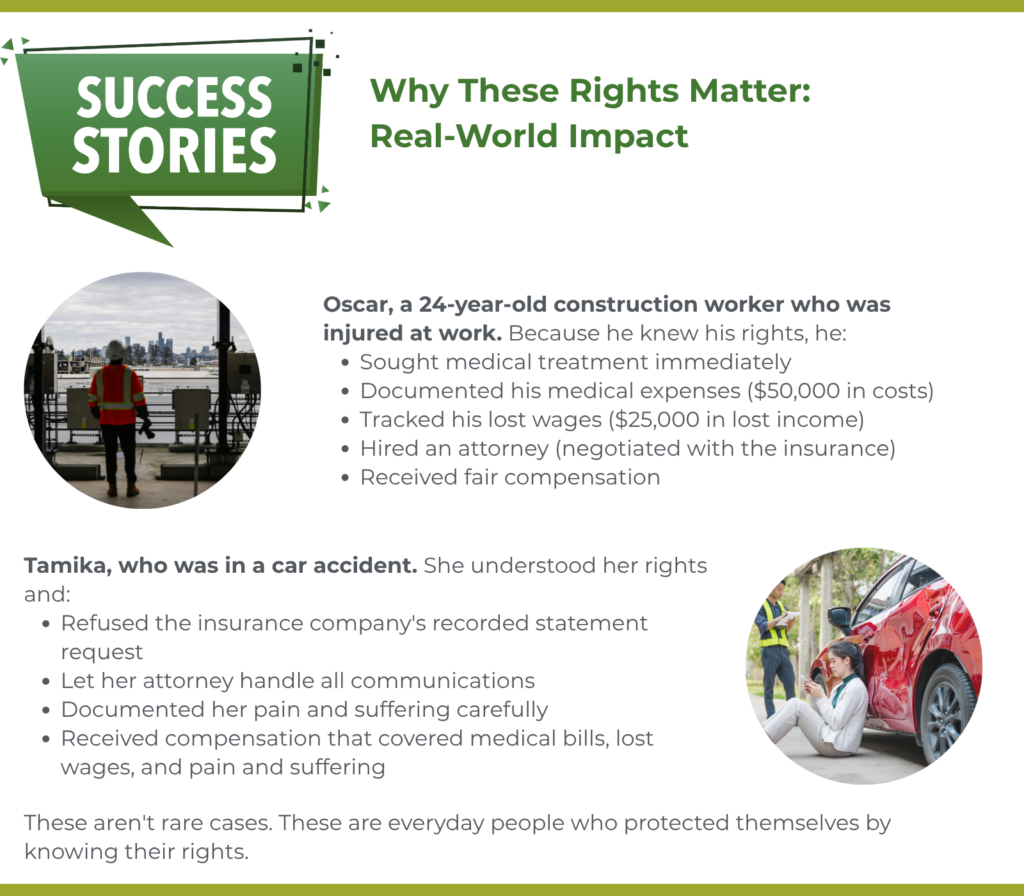
Consider Oscar, a 24-year-old construction worker who was injured at work. Because he knew his rights, he: Sought medical treatment immediately (protecting his health) Documented his medical expenses (proving $50,000 in costs) Tracked his lost wages (showing $25,000 in lost income) Hired an attorney (who negotiated with the insurance company) Received fair compensation (instead of the initial low offer) Or Tamika, who was in a car accident. She understood her rights and: Refused the insurance company's recorded statement request Let her attorney handle all communications Documented her pain and suffering carefully Received compensation that covered medical bills, lost wages, and pain and suffering These aren't rare cases. These are everyday people who protected themselves by knowing their rights.

Your Next Step: Free Consultation

You don’t have to navigate this alone. The Law Offices of Roderick C. White provides free, no-obligation consultations for accident and injury cases. We have over 70 years of combined legal experience protecting people in Texas, Missouri, Illinois, and Kansas.

We understand:

  • How insurance companies try to minimize settlements
  • The medical and financial impact of serious injuries
  • How to negotiate aggressively on your behalf
  • When to take cases to trial for maximum compensation
24/7 Availability | We speak Spanish & English | No upfront costs
i got you

The information in this blog post is general and should not be considered legal advice. Please contact our legal team directly for specific guidance regarding your unique situation.

Share
Share
WhatsApp
Threads