









After a car accident, you deserve fair compensation for your injuries, medical bills, and lost wages. But insurance companies know most people don’t understand how settlements work, and they use this to pay less than cases are worth. This comprehensive guide teaches you exactly how car accident settlements are calculated and how to negotiate for fair compensation in Texas, Missouri, Illinois, and Kansas.
The Settlement Formula: How Much Is Your Case Worth?
Insurance companies use a specific formula to calculate settlement value.
Understanding this formula is your most powerful negotiating tool. According to the American Association for Justice (AAJ), most personal injury settlements are calculated using this method:

The multiplier (also called the “pain multiplier” or “bodily injury multiplier”) is typically 1.5 to 5, depending on injury severity. This multiplier is where many people leave money on the table by accepting insurance company first offers.
Breaking Down Each Component
- Medical Expenses: The actual dollar amount of all medical treatment. This is objective and usually undisputed. It includes emergency room visits, hospital stays, surgeries, medications, physical therapy, and any future medical care you’ll need due to the accident (supported by medical evidence).
- Lost Wages: Income you couldn’t earn because of the accident. Document this with pay stubs, tax returns, and a letter from your employer confirming missed work. For self-employed people, keep detailed business records showing lost income.
- Pain & Suffering (The Multiplier): This is where negotiation happens. The multiplier depends on injury severity:
- Minor injuries (1.5-2 multiplier): Bruises, minor sprains, quick recovery (days to weeks)
- Moderate injuries (2-3 multiplier): Broken bones, significant sprains, recovery takes weeks to months
- Serious injuries (3-5 multiplier): Permanent damage, chronic pain, months of recovery, major life disruption
- Severe injuries (5+ multiplier): Permanent disability, disfigurement, lifelong impact on quality of life
Example calculation:
Medical bills: $10,000
Lost wages: $5,000
Pain & suffering: $10,000 × 2.5 multiplier = $25,000
Property damage: $5,000
Total settlement value: $45,000
But insurance’s first offer: $8,000 (suggesting 0.8 multiplier—intentionally low)
After attorney negotiation: $32,000 final settlement (representing realistic 3.2 multiplier)
Difference: $24,000 more through proper negotiation.
Why Insurance Companies Offer Less: The Psychology of Settlements
Insurance companies use specific psychological and financial tactics to minimize payouts. Understanding these tactics protects you:
Tactic #1: The Low First Offer
Insurance knows that people under financial stress often accept low offers. They’re betting you need money immediately. Their first offer is rarely their final offer—it’s an opening negotiating position. Studies show that insurance first offers are typically 40-60% below fair settlement value (Source: American Bar Association, Negotiation Research Institute).
Tactic #2: Emphasizing Your Delay in Seeking Treatment
Insurance argues that delays in medical treatment mean your injuries weren’t serious. Under state negligence law (requiring proof of causation), they’ll cite your delay to argue your injuries came from other causes. This is why immediate medical treatment is critical—it creates the medical record linking your injuries to the accident.
Tactic #3: Requesting Recorded Statements
Insurance asks for recorded statements hoping you’ll say something they can use against you. Injured people often aren’t thinking clearly right after accidents. Anything you say can be recorded and used to minimize your settlement. You have the legal right to refuse recorded statements (see Tex. Civ. Prac. & Rem. Code § 90.508 for privilege information).
Tactic #4: Requesting Full Medical Authorization
Insurance requests authorization to access your entire medical history, not just treatment related to this accident. They look for pre-existing conditions or unrelated medical issues to argue your injuries aren’t as serious as claimed. This is a form of discovery fishing. Limit authorization to accident-related treatment only.
Tactic #5: Emphasizing No Permanent Injury
If your recovery appears complete, insurance argues you suffered only temporary injury. But “temporary” doesn’t mean painless—you still deserve compensation for the time you suffered. Courts recognize that legitimate pain during recovery justifies compensation even without permanent injury (see general tort law principles applied in Fein v. Permanente Medical Group, 38 Cal.3d 137 (1985) regarding pain and suffering during recovery).
The Settlement Process: 8 Steps From Accident to Payment
Understanding each step helps you navigate the process strategically. The timeline is usually 2-6 months from hiring an attorney to settlement.
Step 1: Report the Accident (Days 1-2)
Report to the at-fault driver’s insurance company. Get their insurer’s name and policy number. But don’t accept any settlement offer yet. Simply report the accident and provide basic information (date, location, vehicles involved). Do NOT discuss the accident details or accept any offer.
Step 2: Get Medical Treatment (Day 1-7)
Seek medical care immediately. Some injuries appear days after accidents. Get a medical exam even if you feel “okay.” Keep all medical documentation: visit notes, test results, prescriptions, bills, and receipts. These medical records become evidence of injury severity.
Step 3: Document Your Damages (Ongoing, Days 1-60)
Create a damages file containing:
- Medical records and bills (every visit)
- Work records (pay stubs, loss of earnings statement from employer)
- Photos of injuries (over time—shows recovery progress)
- Pain journal (daily notes on pain level, activities you can’t do, recovery progress)
- Accident scene photos (if safe to photograph)
- Vehicle damage photos and repair estimates
- Witness information and statements (if available)
Step 4: Contact an Attorney (Before Negotiations, Ideally Days 1-14)
This is critical. Before negotiating with insurance, hire an attorney. Most work on contingency (you pay nothing upfront). Your attorney:
- Reviews insurance’s likely settlement offer
- Gathers and organizes all documentation
- Investigates the accident
- Evaluates liability (who’s at fault)
- Calculates fair settlement value based on comparable cases
- Handles all communications with insurance
Step 5: Send Demand Letter (Weeks 4-8)
Once medical treatment stabilizes, your attorney sends a demand letter to insurance. This letter:
- Explains how the accident happened and establishes fault
- Lists all damages with supporting documentation
- Calculates settlement amount requested
- Sets a deadline for response (usually 30 days)
- Explains why the offer is justified (references comparable cases if needed)
Example demand letter section:
“Our client’s medical expenses total $12,000, fully documented with attached medical records. She missed 4 weeks of work, losing $5,000 in wages (verified by employer letter). Given the moderate nature of her fracture, a pain and suffering multiplier of 2.5 is appropriate, resulting in $30,000 in pain and suffering damages. Her vehicle required $8,000 in repairs. Total settlement demand: $55,000.”
Step 6: Insurance Counteroffer and Negotiation (Weeks 8-16)
Insurance typically responds with a lower counteroffer. Example negotiation:
- Your demand: $55,000
- Insurance counteroffer: $18,000
- You counter: $48,000
- Insurance counters: $28,000
- You counter: $42,000
- Insurance accepts: $38,000
Your attorney knows when to hold firm, when to compromise, and when to threaten lawsuit. This back-and-forth negotiation usually takes weeks. Don’t accept too quickly—research shows longer negotiations yield higher settlements (Source: Journal of Empirical Legal Studies).
Step 7: Settlement Agreement (Final Stage)
When you agree on an amount, insurance sends a settlement agreement. This typically includes:
- Settlement amount
- A “release” (you agree not to sue)
- Possible confidentiality clause (you may not discuss the amount)
- Payment terms and method
Never sign without your attorney reviewing it. Some settlement agreements inadvertently give up rights or contain language limiting your recovery. Your attorney ensures the agreement protects you.
Step 8: Payment and Distribution (1-3 Weeks After Settlement)
Insurance sends a check to your attorney’s trust account. Your attorney deducts the contingency fee (usually 33%), pays any medical liens (bills sent by medical providers requesting payment from settlement), and sends you the remainder. Typically, you receive payment within 1-3 weeks of settlement.
Example payment breakdown ($38,000 settlement):
- Settlement amount: $38,000
- Attorney fee (33%): -$12,540
- Medical lien (hospital): -$3,000
- You receive: $22,460
Key insight: Even after attorney fees and liens, you’re likely receiving far more than the initial insurance offer would have provided.
When to File a Lawsuit Instead of Settling
Sometimes negotiation alone doesn’t yield fair compensation. Filing a lawsuit might be necessary:
- Insurance’s offer is unreasonably low: If negotiations stall far below fair value, a lawsuit shows you’re serious.
- Insurance refuses to negotiate fairly: Some adjusters make only token increases. A lawsuit forces them to take you seriously.
- Your damages are serious: Serious injuries warrant jury trials, which often result in higher verdicts than settlements.
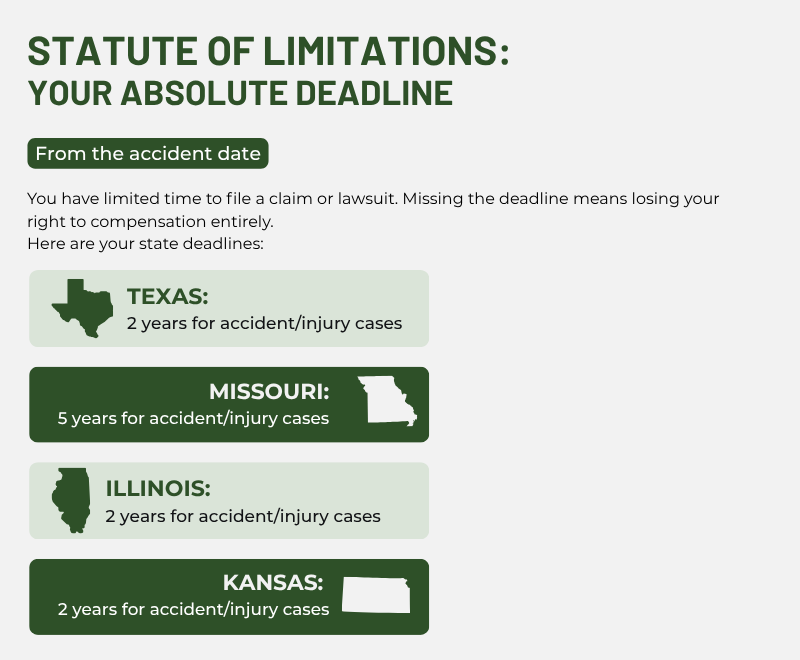
- You’re approaching statute of limitations: If settlement negotiations drag near the deadline, filing a lawsuit preserves your rights.
Don’t fear lawsuits. Most lawsuits settle eventually. Filing a lawsuit simply shows you’re not bluffing. Insurance companies frequently increase offers significantly once a lawsuit is filed, because they now face trial costs and uncertainty.

You deserve fair compensation without the stress of negotiating with insurance.
The Law Offices of Roderick C. White provides free consultations for car accident and injury cases in Texas, Missouri, Illinois, and Kansas.
We handle everything so you can focus on healing. We negotiate aggressively and take cases to trial when necessary.
Call 24/7 at 855-i-Got-You. We speak English and Spanish. Free consultation. No upfront costs. We work on contingency—you pay only if we win.

Q: How long does a car accident settlement take?
A: Typically 2-6 months from hiring an attorney. Simple cases settle faster. Complex cases take longer. The timeline includes gathering medical records, negotiating, and finalizing the agreement. Don’t rush—longer negotiations often yield higher settlements.
Q: Do I have to go to court?
A: No. Most settlements happen through negotiation. If insurance won’t offer fair compensation, filing a lawsuit may be necessary. Filing a lawsuit doesn’t guarantee trial—most lawsuit cases eventually settle. Lawsuits show you’re serious.
Q: How much does an attorney cost?
A: Most work on contingency—33% of your settlement. You pay nothing upfront. If you don’t win, you pay nothing. Your attorney has financial incentive to maximize your settlement.
Q: What if I’m partially at fault?
A: Your state’s comparative negligence law applies. You can recover even if partially at fault, but your recovery is reduced by your percentage of fault. Consult your attorney about your state’s specific rules.
Q: Should I accept the offer or go to trial?
A: Your attorney advises based on evidence strength, offer amount, and likely jury verdict. Settlements eliminate risk. Trials offer higher potential with uncertainty. Trust your attorney’s experience.
Q: What if insurance denies my claim?
A: You can still sue the at-fault driver directly. Your attorney pursues the claim in court. Insurance denial doesn’t end your right to compensation.
Q: How do I know if an offer is fair?
A: Use the settlement formula with an appropriate multiplier. Your attorney compares to similar cases. First offers are rarely fair—they’re opening positions to be negotiated.
Q: Can I settle if I’m still in treatment?
A: You can, but often better to wait until treatment is complete. Once you settle, you can’t get additional compensation. Ensure future medical care costs are included. Your attorney advises what’s best.

The information in this blog post is general and should not be considered legal advice. Please contact our legal team directly for specific guidance regarding your unique situation.